Navigating the industrial landscape of Johor Bahru (JB) for technical components requires a deep understanding of materials, manufacturing processes, and local supply chain logistics. Whether you are running an automated electronics assembly line in Senai, maintaining a chemical processing plant in Pasir Gudang, or designing food packaging automation in Tampoi, sourcing the right engineering plastic is a critical operational decision.
Unlike commodity plastics used for packaging or retail goods, engineering plastics are modified polymers engineered to meet stringent mechanical, thermal, and chemical performance metrics.
This comprehensive guide is structured as a technical FAQ to help engineering professionals, procurement managers, and production supervisors evaluate, select, and source high-performance plastic solutions right here in Johor.
Section 1: Fundamentals of Engineering Plastics
Q1: What exactly defines an "engineering plastic," and how does it differ from standard commercial plastics?
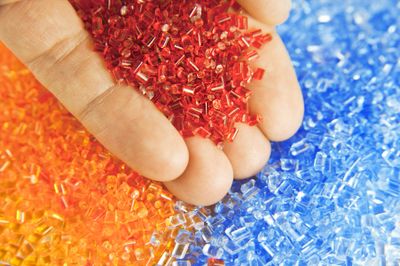
Engineering plastics are a distinct class of thermoplastic materials formulated specifically to provide superior mechanical properties, higher thermal stability, exceptional chemical resistance, and lower wear rates than standard commodity plastics like Polypropylene (PP), Polystyrene (PS), or standard Polyethylene (PE).
While commodity plastics are cost-optimized for high-volume structural shapes, food containers, or basic packaging, engineering plastics are deployed to replace metals (like brass, bronze, aluminum, and zinc) in load-bearing and highly challenging wear applications. They maintain structural integrity, dimensional tolerance, and mechanical strength at elevated temperatures or when subjected to continuous friction and chemical exposure.
Q2: What are the primary classifications of engineering plastics used in JB industrial sectors?
Industrial plastics are categorized by their maximum continuous operating temperatures and crystalline structures. In Johor Bahru's manufacturing sectors, they are divided into three tiers:
- Standard Industrial/Commodity Plastics: Used for low-stress environments, templates, fluid tanks, and basic covers. Examples include Polyvinyl Chloride (PVC), High-Density Polyethylene (HDPE), and standard Polypropylene (PP).
- Engineering Plastics: The workhorse materials for mechanical components, gears, rollers, and precision-machined components. They safely operate in environments up to 100°C to 120°C. Primary examples include Polyamide (Nylon/PA), Polyoxymethylene (Acetal/POM), and Polycarbonate (PC).
- High-Performance/Specialty Plastics: Materials tailored for extreme environments, aerospace, semiconductor processing, and high-temperature operations exceeding 150°C up to 250°C. Primary examples include Polyether Ether Ketone (PEEK), Polytetrafluoroethylene (PTFE/Teflon), and Polyphenylene Sulfide (PPS).
Q3: Why are manufacturers in Johor shifting from metals to engineering plastics for machine components?
The transition from metals like stainless steel, bronze, and aluminum to engineering polymers across JB industrial hubs is driven by measurable total-cost-of-ownership (TCO) benefits:
- Weight Reduction: Plastics are generally 80% lighter than steel and 50% lighter than aluminum. Lower mass translates to reduced inertia, enabling automated conveyor systems and pick-and-place robots to cycle faster with lower energy consumption.
- Self-Lubrication & Low Friction: Many engineering polymers (like oil-filled cast Nylon, Acetal, or PTFE) feature native self-lubricating properties. This eliminates the need for manual greasing, lowering maintenance cycles, and preventing grease contamination in sensitive food packaging or electronics plants.
- Corrosion Resistance: Unlike metals that degrade in the presence of moisture, industrial cleaning agents, or acidic environments, engineering plastics are immune to oxidation and electrochemical rust.
- Noise Dampening: Polymers naturally absorb vibration. Replacing metallic gears and rollers with plastic components dramatically lowers decibel levels on production floors, contributing to safer working environments.
Section 2: Material Selection & Performance Metrics
Q4: When should I specify Acetal (POM) versus Nylon (PA) for mechanical parts?
This is one of the most common dilemmas faced by mechanical engineers in Johor Bahru. While both materials are strong and cost-effective, their performance under environmental exposure dictates their application.
Critical Selector Tip: Nylon is highly hygroscopic; it absorbs environmental humidity. In the hot, humid climate of Johor Bahru, a Nylon gear exposed to ambient air will swell over time, changing its dimensional tolerances and potentially binding a gear assembly. For precise tolerances in humid environments, choose Acetal. If high impact absorption and raw structural toughness are required for heavy machinery rollers, choose Nylon, but account for slight expansion.
Q5: What makes PTFE (Teflon) the go-to solution for chemical and sealing operations?
Polytetrafluoroethylene (PTFE) is a fluoropolymer with unique properties derived from strong carbon-fluorine bonds. It is virtually chemically inert, meaning it will not react with almost any aggressive acid, alkali, or solvent found in industrial manufacturing.
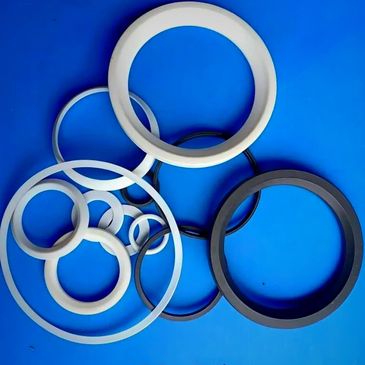
Additionally, PTFE exhibits a continuous service temperature up to 260°C and possesses the lowest coefficient of friction of any solid material. This combination makes it the premier material for gaskets, high-temperature valve seals, chemical pipe linings, and non-stick sliding surfaces. Its mechanical strength is relatively low, so it is frequently filled with glass fiber, carbon, or bronze to enhance its load-bearing capabilities.
Q6: Under what operating conditions must an engineer upgrade to PEEK?
Polyether Ether Ketone (PEEK) represents the pinnacle of high-performance thermoplastics available from specialty distributors in JB. You must upgrade to PEEK when your application demands a combination of all three of the following conditions:
- Extreme Continuous Thermal Stress: Operating temperatures ranging between 150°C and 250°C without loss of mechanical properties.
- High Structural Loads: PEEK exhibits excellent tensile strength and high flexural modulus, allowing it to withstand heavy mechanical loads where other plastics deform or suffer from "creep."
- Harsh Chemical or Steam Exposure: PEEK resists hydrolysis even when exposed to high-pressure steam or aggressive chemical cleaning fluids, a property critical in medical sterilization and semiconductor wafer handling equipment.
Section 3: Sourcing & Logistics in Johor Bahru
Q7: Where are the primary clusters for engineering plastic suppliers and machinists located in JB?
Johor Bahru’s industrial zones host specialized stockists, distributors, and custom plastic precision machine shops. The primary supply ecosystems are distributed across several industrial clusters:
- Tebrau Industrial Estate & Taman Ehsan Jaya: Hubs for general engineering works, plastic sheet/rod distributors, and precision CNC routing services.
- Skudai & Taman Universiti: Concentrated with precision plastic injection molders, tool-and-die shops, and high-performance polymer fabricators supporting tech sectors.
- Senai Industrial Park: Positioned near Senai Airport, this zone focuses heavily on electronics and semiconductor manufacturing components, stocking ESD-safe (Electrostatic Discharge) and flame-retardant plastics.
- Plentong & Masai: Well-positioned for logistics, hosting heavy industrial hardware suppliers, raw sheet stocks, and custom polyurethane casting shops.
Q8: What raw forms are engineering plastics stocked in, and how does it affect processing yield?
Engineering plastics are primary raw materials supplied as semi-finished shapes rather than finished consumer products. When ordering from stockists in Johor, you can buy materials in the following configurations:
- Rods (Round Bars): Ranging from 5mm up to over 300mm in diameter, typically cut in lengths of 1 meter or 2 meters. These are ideal for turning on a lathe to manufacture bushings, gears, spacers, and custom pins.
- Plates and Sheets: Ranging in thickness from 1mm up to 100mm+. Standard stock dimensions are often 610mm x 1220mm ($2' \times 4'$) or 1000mm x 2000mm. These are utilized for CNC milling, wear liners, conveyor guide rails, and structural frames.
- Hollow Tubes: Extruded or centrifugally cast thick-walled tubes, chosen to optimize yield and reduce machining scrap when producing large-diameter sleeve bearings or ring seals.
Q9: Can local JB stockists provide material certifications, and why does it matter?
Yes, reputable engineering plastic suppliers in Johor Bahru can provide regulatory compliance and material certifications upon request. If your manufacturing facility exports products globally or operates under strict quality frameworks, you must demand:
- Certificate of Conformance (CoC): Verifies that the plastic shipped matches the brand grade and exact molecular composition ordered (e.g., virgin resin versus recycled content blends).
- FDA Compliance / EU Food Grade Certificates: Essential if the plastic is being machined into components for food processing machinery or beverage bottling lines (e.g., natural Acetal, UHMWPE).
- RoHS and REACH Declarations: Crucial for the electronics manufacturing cluster in Senai, certifying that the polymer components do not contain restricted hazardous substances.
Section 4: Manufacturing & Fabrication Techniques
Q10: What are the best practices for CNC machining engineering plastics compared to metals?
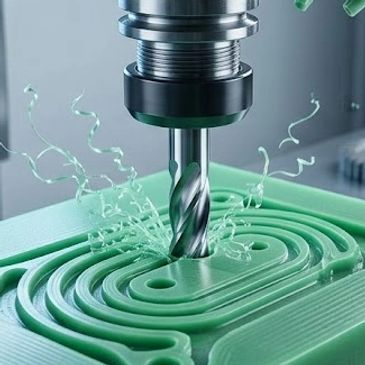
Machining polymers requires a distinct approach compared to working with metals. Plastics have low thermal conductivity and high thermal expansion rates. If a machinist applies metalworking parameters, the plastic component will overheat, melt, deform, or experience dimensional inaccuracies.
- Tooling Selection: Use sharp, polished carbide or diamond-tipped tools with high clearance angles. This reduces friction and ensures clean chips are sliced away rather than rubbed.
- Coolant Integration: Water-soluble or air-mist cooling should be used liberally, especially when machining deep pockets or drilling holes in deep cavities where heat builds up rapidly.
- Feed Rates and Speeds: Run machines at high spindle speeds combined with fast feed rates. The goal is for the cutting tool to carry heat away inside the thrown chip, preventing the heat from soaking back into the remaining stock material.
- Stress Relieving (Annealing): Heavy machining of thick plastic plates can release internal stresses from extrusion. High-precision components should undergo an intermediate annealing bake process to prevent warping after machining.
Q11: When should I choose CNC machining over custom injection molding for my JB project?
The choice between CNC machining from stock shapes versus setting up an injection molding production line depends entirely on part complexity, volume, and tooling budgets.
If you are developing prototypes, specialty jigs, fixtures, or running a production batch of fewer than 1,000 units, CNC machining in JB is the fastest and most cost-effective route. If you are manufacturing tens of thousands of identical housings or clips and can absorb thousands of Ringgit in upfront steel mold tooling costs, injection molding offers the lowest per-unit cost over time.
Q12: How do fillers and reinforcements modify the base properties of engineering polymers?
Raw "virgin" resins can be compounded with additives to significantly enhance specific mechanical properties:
- Glass Fiber Fillers (typically 10% to 30%): Drastically increases the flexural strength and stiffness of plastics like Nylon or PEEK, reducing thermal expansion. However, it makes the plastic abrasive to cutting tools and mating metal shafts.
- Carbon Fiber Reinforcement: Offers the highest rigidity and tensile strength enhancements while reducing overall weight further and providing a pathway for electrical conductivity.
- MoS2 (Molybdenum Disulfide) & Graphite: Added to Nylons and Acetals to lower the coefficient of friction, maximize wear resistance, and increase surface hardness for dry-running bear applications.
- PTFE Blends: Compounded into Acetal or Polycarbonate to create premium self-lubricating sliding interfaces that eliminate stick-slip or squeaking tendencies.
Section 5: Industry-Specific Applications in Johor
Q13: Which engineering plastics are recommended for the food and beverage processing plants in Pasir Gudang?
Food processing and packaging industries are governed by strict sanitation standards. Materials must resist aggressive chemical clean-in-place (CIP) regimens while remaining completely food-safe:
- UHMWPE (Ultra-High-Molecular-Weight Polyethylene): Exceptionally high impact strength and abrasion resistance. Perfect for chain wear guides, star wheels, scraper blades, and slider beds on packaging lines. It has near-zero water absorption.
- POM-C (Acetal Copolymer - Natural/Blue): High dimensional stability combined with resistance to hot water and caustic cleaning compounds. The specialized high-visibility blue food-grade Acetal is frequently specified so that if a mechanical failure occurs, broken fragments can be easily picked up by optical sorting equipment before packaging.
- PTFE: Used exclusively for high-heat packaging heat-sealing bars, baking oven slide pads, and chemical dosing pump diaphragms.
Q14: What materials are ideal for managing ESD (Electrostatic Discharge) in Senai’s electronics cluster?
Standard engineering plastics are electrical insulators that hold static charges, which can instantly ruin sensitive integrated circuits (ICs) during assembly. Electronics manufacturing facilities require specialized materials:
- Antistatic Plastics: Surface resistivity of $10^{10}$ to $10^{12}$ ohms/sq. Prevents static generation on parts trays and assembly surfaces.
- Static Dissipative Plastics (e.g., PEEK ESD, POM ESD, Nylon ESD): Surface resistivity of $10^{6}$ to $10^{9}$ ohms/sq. These materials allow electrical charges to flow safely to ground, preventing sudden discharges during chip testing, sorting, and placement.
- Conductive Polymers: Surface resistivity of $10^{3}$ to $10^{5}$ ohms/sq, heavily loaded with carbon powder or carbon fibers for shielding electromagnetic interference (EMI).
Section 6: Troubleshooting & Problem Solving
Q15: Why is my machined Acetal part cracking or warping after fabrication?
If a precision component made of Acetal (POM) splits, cracks, or warps out of flatness after machining, it is usually caused by one of three common issues:
- Center-Line Porosity in POM Homopolymer: Large diameter extruded Acetal Homopolymer rods can contain low-density porous centers due to volumetric shrinkage during cooling at the factory. If you switch to an Acetal Copolymer (POM-C), you will find a much more uniform center core structure.
- Excessive Machining Heat: If feed rates are too slow, the tool rubs rather than cuts. The accumulated heat expands the material locally. Once un-clamped from the CNC fixture, the uneven thermal contraction manifests as a warp.
- Unbalanced Material Removal: If a machinist skims 5mm off one face of a thick sheet but leaves the other side untouched, the internal skin stresses of the extrusion process become unbalanced, causing the plate to bow upward. Material should always be removed symmetrically from both faces.
Q16: How do environmental factors unique to Johor affect the lifespan of outdoor industrial plastics?
Johor’s geography exposes outdoor materials to high ambient humidity and intense, year-round ultraviolet (UV) radiation.
Standard polymers like untreated Nylon-6, Polypropylene, or Polycarbonate will undergo UV degradation (photo-oxidation) if left outdoors unprotected. This causes yellowing, surface chalking, brittleness, and eventual structural failure under impact.
The Fix: For any structural engineering plastic installed outdoors in Johor (e.g., conveyor components, marine guides, chemical tanks), you must specify UV-stabilized grades. This is commonly achieved by choosing materials compounded with Carbon Black (such as Black Acetal or Black PE), which acts as an efficient UV absorber, blocking harmful radiation from snapping the polymer's molecular backbone.
Key Takeaways for Procurement and Engineering in JB:
When launching an industrial plastic project, avoid ordering material solely by its generic trade name. Follow these steps to ensure perfect execution:
- Define the exact operating temperature range, chemical exposures, and mechanical loads.
- Consult with local specialized distributors in clusters like Tebrau or Skudai early in the design stage to check stock availability for rod diameters or plate thicknesses.
- Ensure that high-precision or specialized components are routed to machine shops that understand the distinct parameters of plastic machining over traditional metals.